Spiegelman’s Story
.jpg)
Art Spiegelman Art Spiegelman is a critically acclaimed and highly influential artist and graphic novelist. He was born in Stockholm, Sweden, in 1948, and soon after immigrated with his parents to Rego Park, a neighborhood of Queens, NY. Though his parents wished for him to become a dentist, Spiegelman enrolled in Harpur College in upstate His early career as an artist began in 1966 at Topps Gum Company, where he drew "Bazooka Joe" comics and helped to create the cult classic "Garbage Pail Kids," which were drawn in a similar style to the popular "Cabbage Patch Kids" dolls but with gross - often vulgar - details. He worked at Topps for twenty years, until a dispute over the ownership of his original artworks caused him to leave. During his time at Topps, he also began publishing his own artwork in underground magazines such as Real Pulp and Bizarre Sex. In 1980, Spiegelman founded RAW (Real Art Works), a magazine of unconventional comics, with his wife, the artist Francoise Mouly. The first volume of Maus was first published in serial form within the pages of RAW between 1980 and 1985, and was released as a book the following year, to enormous critical and popular success. After the second volume of Maus was published in 1992, Spiegelman was awarded a special Pulitzer Prize for his work. In addition to the Pulitzer, he has received several other awards, including a Guggenheim fellowship, an Eisner Award (for "Best Graphic Album"), and a nomination for the National Book Critics Circle Award. In 2005, he was named one of the 100 Most Influential People by Time magazine. Art Spiegelman lives in New York City with his wife and two children, Nadja and Dashiell. Recent works include Little Lit, a series of comics for children, and In the Shadow of No Towers, an autobiographical account of the September 11th attacks and aftermath, told as a graphic novel. His work has been published in the New York Times, Playboy, The Village Voice, and the New Yorker. He received an honorary doctorate from Binghamton University in 1995. | QOUTE "With any work worth its salt, you have to trust the author enough to take its measure. And if you apply too many preconceptions, you are not taking its measure" -Art Spiegelman 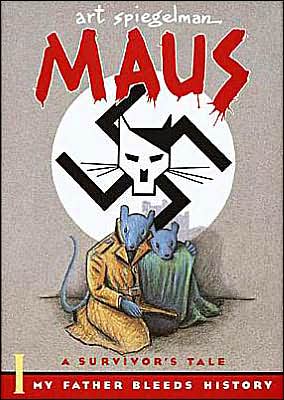 New York Times Review "Maus" represents Jews as mice, Germans as cats, Americans as dogs, Poles as pigs and the French as frogs. Mice and cats summon up the sort of conflicting associations that help to give the comic strip its metaphorical weight. Mice can be either adorable, like Mickey and Minnie Mouse, or the vermin to which the Nazis likened Jews. By exposing his characters to a range of interpretations, Mr. Spiegelman rejects precisely the caricatures that are supposedly a drawback of the comic-strip form." -New York Times |
