Trey Foy
Bography/Identity Project
HUM205 DWM
Ms. Wiske
Spiegelman’s Story

Art Spiegelman Art Spiegelman is a highly influential artist and graphic novelist. His early career as an artist began in 1966 at Topps Gum Company, where he drew comics and helped to create the comic series "Garbage Pail Kids," which were drawn in a similar style to the popular "Cabbage Patch Kids" dolls. He worked at Topps for twenty years, until a problem over the rights of his original artwork made him to leave. During his time at Topps he also worked on his own artwork in underground magazines like Real Pulp and Bizarre Sex. In 1980, Spiegelman founded “RAW” (Real Art Works), with his wife Francoise Mouly. The first volume of Maus was first published in serial form within “RAW” between 1980 and 1985, and it came out as a book the following year, to Arthurs surprise the book was a major success. He also was named one of the 100 Most Influential People by Time magazine. Art Spiegelman currently lives in
| QOUTE "With any work worth its salt, you have to trust the author enough to take its measure. And if you apply too many preconceptions, you are not taking its measure" -Art Spiegelman 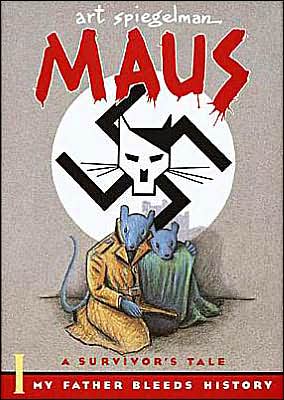 New York Times Review "Maus" represents Jews as mice, Germans as cats, Americans as dogs, Poles as pigs and the French as frogs. Mice and cats summon up the sort of conflicting associations that help to give the comic strip its metaphorical weight. Mice can be either adorable, like Mickey and Minnie Mouse, or the vermin to which the Nazis likened Jews. By exposing his characters to a range of interpretations, Mr. Spiegelman rejects precisely the caricatures that are supposedly a drawback of the comic-strip form." -New York Times |
